B2B vs. B2C Fulfilment in Canada: What Changes When You Sell Across Multiple Channels?
Share:
People often talk about fulfilment as if it’s one process: an order comes in, the warehouse picks it, packs it and ships it. But fulfilling an online order for an individual customer and fulfilling a purchase order for a major retailer can be two very different operations, even when the inventory is sitting on the same shelf.
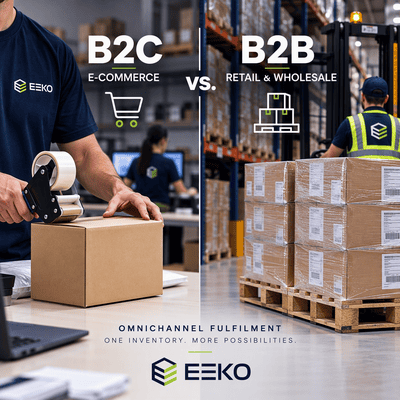
With direct-to-consumer e-commerce, the focus is generally on processing a large number of relatively small orders accurately and efficiently. One customer buys three products, another buys one, and someone else orders six different SKUs. The warehouse needs to pick the correct units, pack them appropriately, generate the shipping label and get the order into the parcel network.
At volume, small inefficiencies add up quickly. If inventory is in the wrong location, packaging isn’t readily available or orders constantly require manual intervention, the operation gets slower and more expensive. Good B2C fulfilment is really about making a large number of individual orders accurate, efficient and repeatable.
B2B fulfilment is a different operation
Now consider that same brand receiving a purchase order from a retailer. Instead of three units going into a small shipping box, the warehouse may be preparing cases, cartons or pallets containing multiple SKUs.
Picking the correct inventory is only one part of the job. The shipment may also need to meet the retailer’s specific requirements for packing, labelling, documentation, pallet configuration, routing and delivery.
This is where B2B experience matters. A warehouse can pick every case and every SKU correctly and still get the shipment wrong.
For example, a PO might call for 20 cases each of four SKUs. The warehouse picks the exact quantities and adjusts the inventory correctly, but if the required pallet type, labels, documentation or routing instructions aren’t followed, there can still be a problem at the receiving end.
That’s why with B2B fulfilment, we have to think beyond picking accuracy. Where the order is going matters.
Omnichannel makes inventory management even more important
The operation gets more interesting when a brand sells through multiple channels. The same inventory might be supporting the company’s own e-commerce store, Amazon FBA, independent retailers, distributors and larger retail accounts.
Each channel can require a different fulfilment workflow, but they’re all drawing from the same inventory. That’s why I don’t really separate inventory management from fulfilment. You can’t reliably fulfil what you can’t accurately locate, count and allocate.
Before a B2B order is picked, the warehouse needs to understand what was ordered, the quantities and units involved, how the product needs to be packed and labelled, what documentation is required, whether there are routing instructions and when and where it needs to arrive.
You’re essentially working backwards from the receiving requirements.
Growing into B2B changes the warehouse operation
This is something growing brands can underestimate. Going from 100 e-commerce orders to 500 is largely a question of capacity, systems and process. Adding a major B2B account can introduce a completely different set of requirements.
Now the fulfilment operation might need to handle B2C orders, retail POs and Amazon FBA preparation from the same inventory. Same brand and same products, but very different ways of getting them to the customer.
That’s where experience with omnichannel fulfilment helps. The warehouse needs systems and processes that can support individual-unit picking for e-commerce, case and pallet orders for B2B, and the preparation requirements that come with channels such as Amazon FBA.
What should you ask a 3PL?
If your business sells through multiple channels, don’t just ask a potential 3PL whether they “do fulfilment.” Ask how they actually handle the different ways your products are sold.
Can they manage individual-unit, case and pallet picking? Can the same inventory support B2C and wholesale orders? How do they deal with customer-specific labelling, retailer routing instructions, documentation, kitting, relabelling and Amazon FBA preparation? What is their frequency for shipping into locations such as Walmart, Costco and TJX?
The goal isn’t to find a warehouse that simply says yes to everything. It’s to find an operation that understands how your company actually sells its products and what has to happen to an order before it leaves the warehouse.
At EEKO, we have years of experience supporting omnichannel brands across B2C, B2B and Amazon FBA, with warehousing and inventory management tying those channels together. When you’re selling in more than one place, order volume is only part of the conversation. Where the product is going, how it needs to be prepared and what the customer expects when it gets there all matter.
Anyone can put product on a pallet and get it out the door. The real work is making sure it’s prepared properly for whoever is receiving it.
That’s how we look at B2B fulfilment: not just “Did it ship?” but “Did it ship right?”